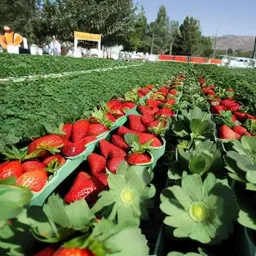
Strawberries come in three main types: June‑bearing (spring), ever‑bearing, and day‑neutral. Ever‑bearing and day‑neutral plants are best for home gardens because they give fruit twice a year or throughout the summer. Plant them in dry soil in spring, covering only the roots, and make sure containers are deep enough and have drainage holes. After each harvest, remove many old plants (renovation) and add a little fertilizer so new plants can grow well. California produces most U.S. strawberries, and the Garden Grove Strawberry Festival celebrates the fruit each year.
- ever bearers
- Definition: strawberry plants that, after the last winter freeze, produce fruit in spring or early summer and may produce a second crop later in the season.
- Example: "Ever bearers, when planted after the last winter freeze, will produce fruit during spring or early summer."
- renovation
- Definition: the practice of removing many old strawberry plants after they have fruited so newer plants can replace them, often followed by fertilizing.
- Example: "Renovation means removing a lot of the old plants to let newer ones replace them."
- runners
- Definition: shoots that grow from the base of strawberry plants and spread to form new plants, appearing a few weeks after planting.
- Example: "Runners will appear in a few weeks."
- loamy soil
- Definition: soil that contains enough organic material to let water pass through easily, providing good growing conditions for strawberries.
- Example: "Strawberries grow well in loamy soil that lets water pass through easily."
- festival
- Definition: the annual Garden Grove Strawberry Festival that celebrates strawberry heritage with events such as a parade, carnival rides, and a giant strawberry shortcake.
- Example: "The fifty-first year of the Garden Grove Strawberry Festival is this weekend south of Los Angeles."
- Which type of strawberry is described as being ready in the spring and also called spring bearing?
- Day neutral
- June bearing
- Ever bearer
- None of the above
- According to the report, when should strawberries be planted in the spring?
- After the last winter freeze
- As soon as the soil is dry enough
- Only on a sunny day
- When the soil is saturated
- What soil depth is recommended for strawberries grown in containers?
- 10‑15 centimeters
- 20‑25 centimeters
- 25‑30 centimeters
- 35‑40 centimeters
- Which university extension suggests mixing about three to five percent organic material into the soil?
- University of Illinois
- Colorado State University
- University of Tennessee
- Virginia Tech
- What is the name of the karaoke singing contest at the Garden Grove Strawberry Festival?
- Strawberry Idol
- Berry Battle
- Festival Sing‑Off
- Karaoke Strawberries
- Do you think ever‑bearing strawberries are better for home gardens than June‑bearing ones? Why?
- Have you ever grown strawberries or other fruit at home? Share what you learned.
- Why does the article recommend planting strawberries late in the day or on a cloudy day?
- What might happen to strawberry plants if they are not renovated after the harvest?
- The article says renovation should be done every year. Do you think this is necessary for all strawberry growers? Explain.
- Some people think adding nitrogen fertilizer is essential, while others worry about over‑use. Which side do you support and why?
- Imagine a new strawberry festival in your town. What three activities would you include?
- If you could design a strawberry plant that produced fruit all year round, what features would it have?
- Do you think festivals like the Garden Grove Strawberry Festival help preserve local history? Why or why not?
- How does mixing organic material into the soil help strawberries grow better?

Grow It Yourself: Strawberries
This is the VOA Special English Agriculture Report.
One of the sweetest gifts of nature is a red, ripe strawberry. There are three basic kinds of strawberries: June bearing, ever bearing and day neutrals.
June bearing are ready in the spring, so they are also called spring bearing. But gardeners will not get a crop during the first spring after planting.
Ever bearers, when planted after the last winter freeze, will produce fruit during spring or early summer. A second or sometimes third crop will be ready in late summer. Day neutrals produce fruit throughout the summer months.
The University of Illinois Urban Extension says ever bearers and day neutrals are especially good for home gardens. Plant strawberries in the spring as soon as the soil is dry enough.
Try to plant late in the day or on a cloudy day. The soil should cover just the roots and not the crown on top of the plant. Runners will appear in a few weeks.
Strawberries grown in containers need a soil depth of about twenty-five to thirty centimeters. Be sure the container has holes in the bottom.
Strawberries grow well in loamy soil that lets water pass through easily. Carl Wilson at the Colorado State University Extension suggests mixing about three to five percent organic material into the soil.
Part of caring for strawberries is renovation. Once the plants have produced fruit, they become less productive. Renovation means removing a lot of the old plants to let newer ones replace them. The Agricultural Extension Service at the University of Tennessee says growers should do this every year after harvest.
Renovation also includes adding fertilizer. Adding nitrogen as a side or top dressing in late summer will supply nutrients to the fruit buds for the following spring.
California grows most of the strawberry crop in the United States. The fifty-first year of the Garden Grove Strawberry Festival is this weekend south of Los Angeles. The Web site Strawberryfestival.org says it began as a way to bring the city of Garden Grove together. A local public relations man suggested a celebration of the area’s once plentiful strawberry fields.
It grew into one of the largest community festivals in the western states, complete with the world’s largest strawberry shortcake. The festival has a parade, carnival rides, games and a karaoke singing contest called “Strawberry Idol.”
And that’s the VOA Special English Agriculture Report, written by Jerilyn Watson. For more gardening advice, go to voaspecialenglish.com. I’m Faith Lapidus.
Related Articles

TOEIC - Level 2
97 Pages
6-Minute English
70 Pages
News in Slow English
60 Pages